Burying the Fig: Emilio DeGrazia
Emilio DeGrazia
Edegrazia@winona.edu
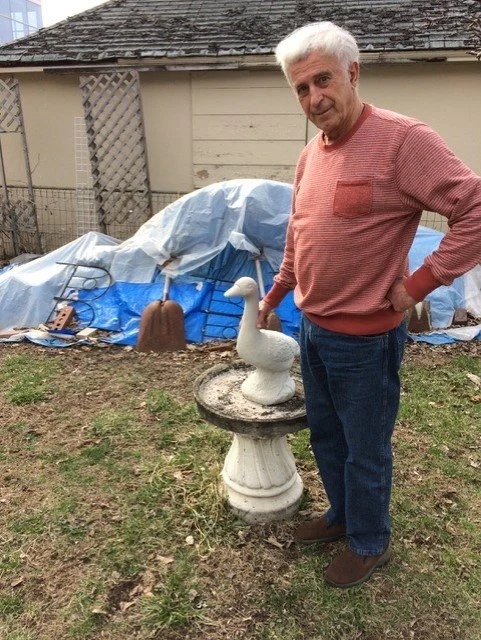
There is something permanent about the picture of my father by the old fig tree in our suburban Detroit back yard. I see him loitering around the tree’s hem, as if his presence will coax favors from this mistress long-accustomed to fulfilling her promise in good slow time. On blue late summer days he offers a handful of figs all around, a smile on his face as he opens one with his thumbs for everyone to see inside. All the work he did in the yard––from saving old boards in the shed to staking tomato plants with strips of rags––resolves itself into the image of him next to that tree. It’s an old black and white photo I carry in my mind––one strangely suffused with the early-evening colors of summer fields and blossoming things.
A fig tree in a suburban Detroit back yard––so out of place. Like Frost’s peach tree trying to survive a winter storm in Vermont.
We think of the tree. If it never again has leaves,
We’ll know, we say, that this was the night it died.
Detroit’s winter storms are enough to do a fig tree in, especially since all trees there contend with elements manufactured into urban blight.
No one knows for sure how the first fig tree arrived. Peasants from southern Italy who came to American shores a century ago smuggled a few sprigs in with their other goods. Imagine what went into those leathery suitcases as weather-worn as the people who lugged them off the boats: The suit he was married in and her wedding dress; the pillowcases she herself embroidered on long winter nights; a few special dishes inside towels and underwear; a pot and pan; birth certificates and old deeds; browned photos of members of the family, the piazza, the goat left behind; and thick slices of dried hard bread wrapped in a linen cloth. Essentials. Among them, carefully bedded inside a sheet or the arm of an old wool coat, a green-stemmed branch of the fig tree still standing next to a road leading from and to a town.
The sprig endured the Ellis Island lines, gave customs the slip, ended up on a train heading to New Jersey or Boston or Pittsburgh or Detroit, surviving on its own green sap until one day rough hands dug a small hole and gave it a place in American soil.
By the time my father abandoned Detroit for a retirement house in Florida, his tree had grown to over twenty feet. Its origins are as obscure as a piece of contraband, the name of its Old World home and original smuggler lost to memory. As it grew it established the legitimacy of its family line, becoming the stem for other branches of a community bonded more by language than by blood or place. “This is Don Vincenzo’s tree,” I see my father saying to me. “It’s from your uncle Tony Posa’s tree, the little one in back, and he got his from Pasquale Bruno, who got his right from Don Vincenzo’s tree.” Though Pasquale was not related to Don Vincenzo in any way, and though Don Vincenzo was long dead and gone, once named the old Don’s tree held sway. On August evenings when the men gathered in each other’s yards to feast on wine and talk in the language they never left behind, the figs they tasted were all from Don Vincenzo’s fabled tree. And when it was time for newcomers to be cut in, it was somebody’s version of Don Vincenzo’s tree that was broken off and offered around like pieces of bread to strangers on trains.
The poet Frost, perhaps because he felt the cold not only in his name but in his bones, understood the fig tree problem well:
What comes over a man, is it soul or mind––
That to no limits and bounds he can stay confined?
You would say his ambition was to extend the reach
Clear to the Arctic of every living thing.
Why is his nature so hard to teach
That though there is no fixed line between wrong and right,
There are roughly zones whose laws must be obeyed?
The fig tree in Detroit was not merely displaced; it was, like its devotees, out of place. Most of the immigrants from southern Italy who came to America did not abandon a nascent nation-state existing mainly in the minds and bureaucracies of liberal reformers from cities in the north; they left behind the Old Country, an impoverished but ancient way of life defined by the climate and landscape of their Mediterranean world. The Old World tax collector often took what he could get––a cheese, chicken, goat, or promise––from peasants who mined the soil for their only currency, the earth’s vegetables, grains, and fruits. When American trains took these peasants further west and north, mainly to factory work in cities frozen a good part of the year, they found themselves increasingly out of touch with warm skies and the rough dry soil that had to be coaxed into providing them the stuff of life.
Many, including my father, threatened to return to the Old Country for good, their debates, often articulate and hot, lasting into the night. America yes, but America no. Yes, there was work, a necessity, and there was money, a luxury, here too. Indoor plumbing, a washing machine, and maybe someday a car. Who would ever have these things over there? But something was lacking here.
How to find words, the right word? Respect. Men who never went to church required respect for some sort of God, for just and often unwritten laws, for learning, for the authority of parents and the innocence of girls.
And so much taste had been lost. The fruits and vegetables in the stores were never fresh enough; the meat had a strange stink; and the water never turned into wine quite as clear and fragrant as the wine back home. A few returned to the Old Country for good, others to visit villages, aging parents, wives left behind. But most, not quite mindful of how way leads on to way, found themselves on ever-widening American highways inexorably leading them further from each other too.
Confronted by a Great Plain opening itself to the leveling of identity, the new arrivals tried to regroup along Old Country lines. In cities Italian neighborhoods formed, the groceries and delis dense with imported aromas and tastes. In homes the old rules still held: Papas, absent in their work, pretended to their habits of command, while Mamas, lost indoors most of the time, made the decisions and all the beds and bread. On Saturday nights everyone went to the wedding at the Italian-American hall, and as midnight neared even the old people who sat sad-faced watching the dance leaped up to do the tarantella one more time. Late October was sausage-making time, many old hands cranking away at the handle of some uncle’s meat grinder; that was also when a delegation went to the railroad yards to check out the California grapes. All was momentarily right with the world when the fragrance of newly fermenting wine filled the house.
But these were a people––most of them––who for centuries had made a living off the land. What they understood best was the struggle––and habits––of small growing things. For them the weather was more than the stuff of small talk, medium of social relationship; it was vital friend or foe. The earth’s temperament was craggy and dry, its good humors dragged out of it with a hoe. It was a terrible shame to waste anything, for everything had some use. The ground had the strange power to purify, turn manure into tomatoes and beans. Life was not merely life but La vita, the word’s definite article at once drawing attention to life’s finite singularity and to a special wholeness deserving a proper name. For the peasant the hours were full of toil, survival dependent on sky’s balanced relationship with soil. There had to be moments when men and women stood back from their work in awe of the incomprehensible beauty of their terrible world. Yes, despite the priests, God did exist, somewhere out there in the landscape, his rule as arbitrarily mysterious as some monarch or dictator presiding in a distant Rome, but sacred because ultimately good. And Evil was out there too––omnivorous, persistently crowding in on the small good things, its craving for more than its lush share wasteful and unbalanced. Like weeds. Therefore those who went wrong had to be taken in hand personally and pulled out by the hair.
My father was like many of them––a peasant farmer whose New World work took him into the coke ovens and open hearth of the Ford Rouge plant. Plant and hearth indeed, this massive and bizarre configuration of sheds, smokestacks, and pulleys that took earth’s elements in and subjected them to a series of alchemical processes resulting in miles worth of cars and mountains of waste. Black-faced from the smoke and grime, my father spent many a dark day––thirty-three years, a Christ’s age––doing his part to translate the ore from the Minnesota iron ranges into the gold that never materialized as he waited in line to be handed his paycheck every week. Prosperity followed unnaturally enough.
After working the fires of the coke ovens and open hearth he went home to Old Country work. Somebody’s brick or stonework needed repair––the work of hands and ancient chemistries. In the small garden in back the grapevines went up with the trellises that walled the yard in green, as if to enclose the tomatoes, peppers, and eggplants into a world of their own.
But the little New World garden was inevitably done in by the cold. Terra maligna––the sky too perpetually gray, the tomatoes wilted by frost before October first, the winter indoor life with its aching moments given to staring through windows at someone else’s barren yard. Did one look east or west for a glimpse of mountain and sea? Something important was missing here.
I imagine my father conjuring the fig tree at the end of a long February day. March had yet to show itself, but April, also still hundreds of miles away confusedly east and west, eventually would melt the snow. Tony Posa had buried a fig tree under bales of straw in his back yard. If Tony Posa’s fig survived the winter this year, why wouldn’t one survive in the little piece of ground next to the garage? I see my father’s eyes narrowing as the calculations run through his mind. How much sun would the tree really get, how much garden space would be lost, and how many years to a handful of figs? He begins seeing it––higher than the garage, its leaves spread on the roof, taller by far than Tony Posa’s puny thing. He would water it every day and shield it from the cold with huge bales of straw.
What comes over a man, is it soul or mind––
That to no limits and bounds he can stay confined?
Thus Henry Ford’s Igor, my father, resolves to challenge nature and try his own experiment with the elements.
Did he make my mother a happy woman that night?
As soon as it is warm enough for Tony Posa to roll the bales of straw away from his tree, he takes Tony a bottle of wine and returns home with a sprig of his own. He keeps it in a canning jar for more than a month, standing over it with thoughts more tangled than the tendril roots that finally appear in the brackish water. On a warm rainy night in late May I see my father digging in the yard, the jar at his side. He mixes sand from a bucket with the rich loam he has prepared, then finally puts the sprig in the ground, pats the soil all around, and steps back to behold his work. Day after day he waters it from an old coffee can, now and then turning the soil with a screw driver. For the longest time it looks like nothing more than a bare brown stick in the mud, my father, himself brown but showing the first signs of gray, with wordless soundings trying to tease some response from it.
Finally buds appear and then overnight the first small leaves. And what beautiful leaves, especially in miniature––their bright dark greens, soft and thick, deepening one of nature’s lovely designs furled in on itself like an embryo. All through that first fig tree summer the unfurling goes on, the tiny leaves broadening into small garments perfectly cut to reveal the beauty in any Eve’s form.
“Two more years,” my father boasts, “and we’ll have figs.”
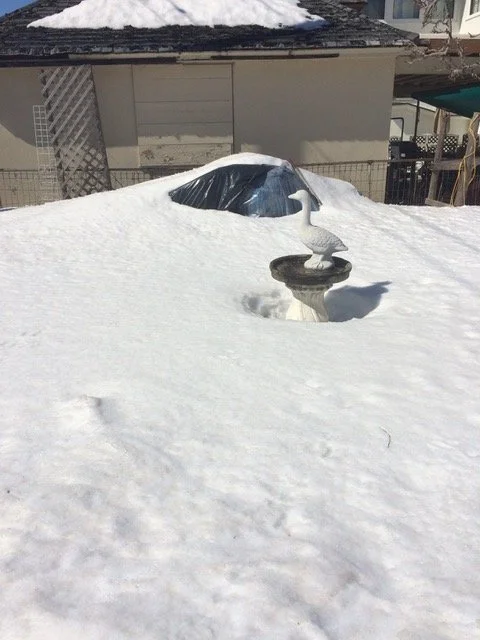
The chill always sets in long before September first, usually on one of those rare blue summer evenings when all seems right with the world. I catch my father gazing at the tree, his nerves on edge. Now what, when the cold weather comes on? He waits and watches as the leaves fall from the spindly tree, then on a late October Sunday morning he’s in the yard again. First he bends the tree toward the ground, and ties it down with a rope. Around it he piles leaves and grass, and on top bushel-basketfuls of manure hauled in from the countryside, this heap eventually walled in by tightly stacked bales of straw.
My mother laughs. “Look at that monument. Like a castle with walls three feet thick. Maybe we should go live in there.”
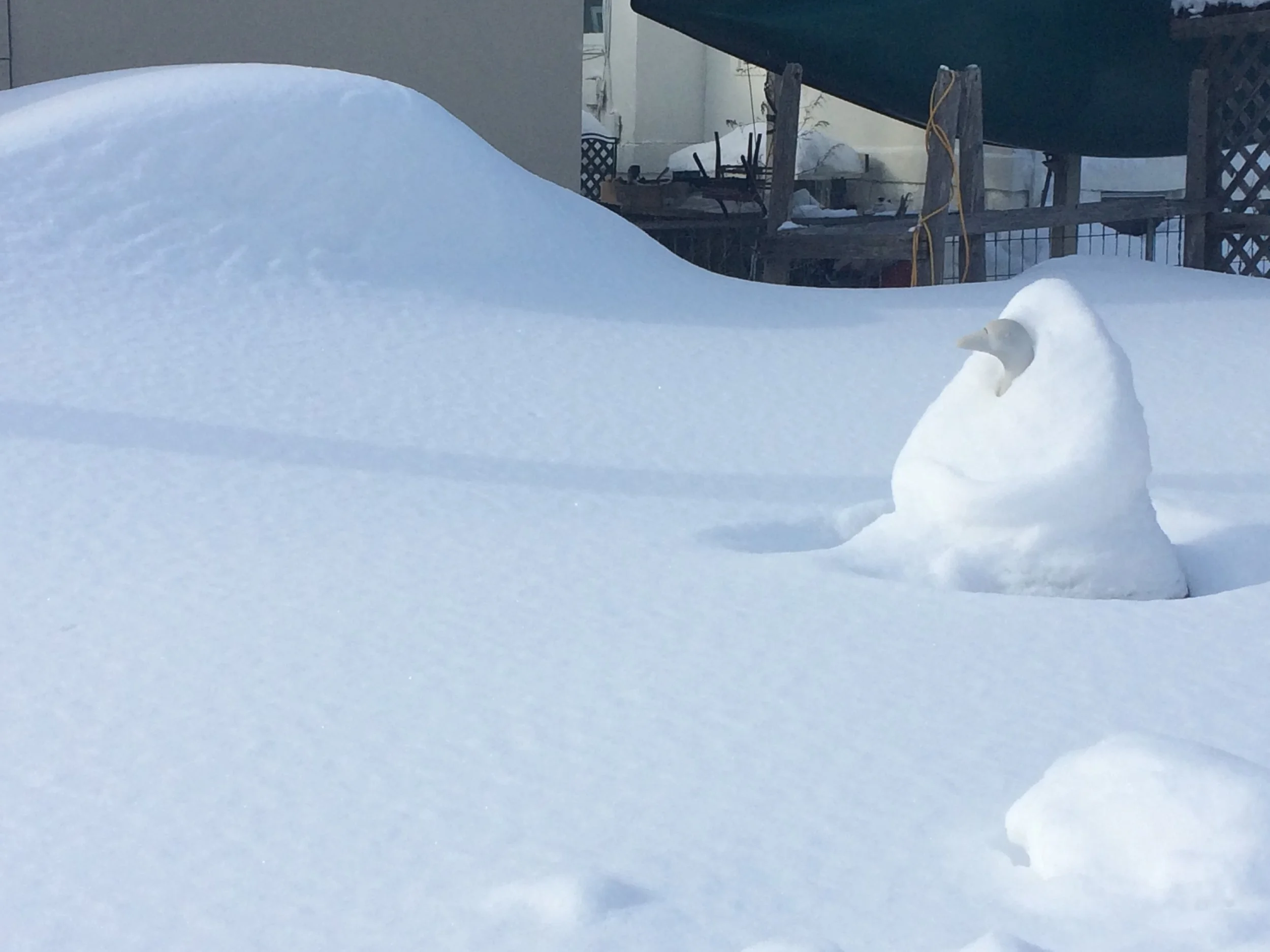
The first snows melt into the monument, but my father keeps shoveling the stuff onto the heap. As the temperatures fall only the topmost bales are visible above the snow the winds have sculpted into a pyramidic swirl. What was he thinking about on sleepless nights? Bills to pay and too much work to do on the house after work. My mother unhappy and shrill. And a letter announcing that his mother, at ninety-one, is very ill. Will he ever return to Italy?
He now knew how way leads on to way, how the chain reactions of choice preclude returns. As the snows melt away from the base of his straw castle in early May, he stands next to it looking at the sky as if a God up there is someone he knows too well and doesn’t trust. Then one day the impulse suddenly comes on. He marches into the yard, pulls the bales aside, and begins digging away at the mass of manure and rotting leaves. Finally he finds the cord, cuts it with a knife, and lifts the tree out––the main stem filthy in an ooze I dare not touch. He smiles as he points at tiny nubs of green already emerging along the stem.
Every day after work he waters it from a hose, then stands hands-on-hips as if waiting for it to grow in front of his eyes. It grows to five feet in that summer’s heat, its leaves blossoming into a full green canopy, and that winter the bales of straw are heaped so high the snow doesn’t reach half of them. The following spring he reaches into the muck and pulls it out again, tying it to a stake until it stands straight on its own. More nubs appear, the precious figs, only to shrink by mid-summer and fall off one by one. Tony Posa keeps coming over for a glass of wine, carrying with him a few of his own figs wrapped in a white linen cloth. “Next summer,” my father says, “I’ll be drinking your wine.” “Maybe,” Tony replies with a downward curl of his lips, “ifa you bury ‘er good.”
Bury a tree?
The next summer the tree is way over my head, and the figs––stiff and erect, like inverted green raindrops––begin showing themselves inside the canopy of leaves. Eventually they began to turn purple in the August heat; they sag and one day finally fall into my father’s hands. “Here,” he says, as I take note of a drop of milk oozing from its stem, “like this.” With his thumbs he splits it open for me to look inside. What do my teenage eyes see as I gaze into the pink seed-filled flesh? Something I had not seen before. My father lifts it closer to my lips. “Here, taste it.” “Yuk,” I say as I give it a few turns in my mouth and force it down.
Taste naturally matures when given proper respect, as do memories. For many years I walk right past the ripening figs, not suspecting that my father harbors a secret desire to hoard them all. My innocence does not allow me to care. The taste of figs is as un-American as my parents when they jabber in Italian in front of my friends. The difference in taste is widened by the distance between my boyhood and my father’s youth, an age measurable by the miles separating the New World highways from the Old World paths. Rather desperately I want to look and feel American, and this requires further distancing. Much later––when I begin seeing my future in my past––I develop a desire for figs.
Where was my father looking––forward or back––when he made his decision to defy the northern elements? Like all of us, he was Janus-faced. And because there are roughly zones whose laws must be obeyed, he paid for getting cocky with the tree. The tree grew and grew, and the winter tower made of straw bales began to climb into the sky. Even as the tree began dwarfing him he stood tall next to it, as if to take full credit for its spectacular growth. Look at the work of my hands, his smile seemed to say whenever some figless friend dropped by. “I could sell these in a store. I could get rich with these.”
He was rich until he, and the tree, got too big. The November day arrives when the tree has achieved such girth that it refuses to bow down easily for him. He stands in the yard looking at it, sullenly calculating, then gathers his tools and begins his sawing and hammering. When he is done he stands back to admire his new work, a wooden shack built around the tree from old boards. Then he begins lurking in neighborhoods in search of leaves, returning to the yard to stuff them in the shack. When late November temperatures foreshadow a winter unusually cold, he goes in search of straw bales to pile around the shack. Though in America the common faith is that everything looks up, the tree catches the cold and dies. Tony Posa’s tree, only half as tall, survives. “Lika I tole you longa time ago,” Tony says, “you gotta bury ‘er good.”
The following spring when Tony unburies his tree, my father, this time full of sullen respect for the American elements, starts all over again with a new cutting from it. From then on he trims the tree back to its proper bounds, digs a trench along the base of the garage, bends the tree into the trench, ties it down and buries it. When the snows come it looks enough like a grave to inspire me to imagine who might be buried there. For the first time I see my father dead, and when my mind reels away I see the grandfather in Italy I have never seen. It takes years more for me to see that I am buried there too.
My father’s new tree eventually blossoms again, growing hardier as he cuts it back and buries it each year. But in the umbrage of the giant maples, elms, and oaks skyscraping the neighborhood the fig looks like a dwarfish weed. The limbs of the big trees, nature’s monuments, crowd the heavens as if lifted to honor the gods of sky, the powerful grip their roots have on the earth too deep to be visible. The little fig reminds us of the presence of the underground life, its widespread tendril roots drawing the milk for its fruit from moisture on the earth’s skin. Sensitive to the effects of frost that creeps up limbs like the hemlock Socrates drank, the fig seems more directly in touch with the life-and-death powers of earth.
We would have to fell a forest to produce the pulp necessary to properly celebrate this plant. It’s not enough to note that trees, enduring in all but virtually lifeless cold, provide all manner of nuts, berries, and fruit, their wood shelter and heat, their foliage the very air we breathe. Standing there at the interstice between Sky and Earth, its natural art configuring the cross between our high yearning for transcendence and the limitations of our base humanity, my father’s little fig tree grows in significance as I begin to see it against the ancient backgrounds detailed by Sir James Frazer and Joseph Campbell, those great loggers of arboreal rituals and myths. Though trees are said to be the source of home remedies for all manner of human ills––an infallible way to make hair grow long, for example, if we do as the Lkungen Indians of Vancouver Island do and mix fish oil with the pulverized fruit of the poplar Populus trichocarpa; though in Central Australia a man is said to be able to blind his enemy by rubbing himself against a tree that springs up on the spot where another blind man has died; though there is much to be said for (and against) that sacred tree in the grove of Aricia guarded by a grim figure, at once priest and murderer, trying to prevent his successor from plucking the golden bough that provides his challenger the right to rule; though many unlettered peoples deem trees animate and sensitive––the Ojibways reluctant to cut them down out of concern for inflicting pain, trees in many Chinese books bleeding and uttering cries when hacked or burned, and trees embodying the souls of dead ancestors in many parts of the world; though we learn that the great northern forests are the original Gothic “temples,” embodiments of the Life-Spirit, and that the Swedes, Slavs, and Lithuanians were tree-worshippers before their conversion to the faith symbolized by the Calvary and Christmas trees, just as Romulus’ sacred tree, also a fig, was worshipped in the Roman Forum until it was supplanted by the Cross; though that cunning adventurer-murderer Odysseus carved his marriage bed, peaceful stage of his odious dramas, out of the bole of a great olive tree, and Aeneas, his successor of sorts, also had to fetch a golden bough in order to achieve his triumphal journey to the underworld; and though several myths have at their center a drama featuring woman, serpent, man and tree, their setting a garden radiant in the sun, the Tree of Knowledge (and of Good and Evil) synonymous, in some of these myths, with the Tree of Immortal Life: Yet the tree looms largest when the great poets––among them Blake, Shelley, Yeats––figure the tree as the human mind, great-rooted blossomer of intellect, imagination, and song.
All this in my father’s little fig tree, which I hereby name my family tree.
What seems obvious enough about family trees is the visible part, whose branches seem anatomically correct for delineating the proliferation of offspring from some (usually and merely conventionally) paternal main stem. When we genealogically draw them up the usual question is how far out to go––whether to include uncles and aunts, their children and their children’s children too. At some point we prune, lest family members become as plentiful as leaves. But more significantly we cut the family tree off at ground level too, usually at the point where memory begins drawing a blank, the root system and its tangle of ganglia not only invisible but buried as if dead. If we start going down and out along the root-ganglia into dark history, beyond great-great grandpersons toward those strangers preceding them, ones with un-familiar names, we have to think in migratory terms: In my case Italians devolve into Romans, Goths and Huns, and certainly Greeks before them, all lineage an incestuous stew of “bloods” drawn by invading warmongers and their hoards. I find my family ganglia tangled with Saracen colonizers from North Africa, see their ancestors coming north across vast deserts to gaze at the Mediterranean, their grandparents perhaps from the bush country near some tropic river overgrown with jungle trees in which monkeys sit jeering down at us. I, child of southern Italians whom northerners jeeringly call terroni, earthlings, see my origin as a stew of Adam, Red Clay, and Eve, Life Force, brought into being by a chance lightning bolt that perfectly shocked some haplessly swimming string of DNA.
The mind reels, flies from that swamp.
So where are we now, we terroni, all so cut off from each other and our origins?
Last spring my mother, on her way north from Florida, visited her eighty-six year old sister in Chicago. Her brother, my Uncle Sam who lives in Skokie ten minutes away, could not manage the time to connect, and my mother, who never struck a final truce in their old sibling wars, didn’t really mind that she probably would never, ever, see him again. I make an annual pilgrimage from Minnesota to Detroit to visit my sisters, but only twice in twenty-five years have they come my way. Since my parents now reside in Florida, we each see them once, maybe twice, a year. Recently I criticized a divorced ex-friend for trying to advance his new wife, also divorced, ahead of others more qualified for a job. “Bah! It all comes down to family!” he replied. Nepotism indeed––sans nephews, nieces, cousins, uncles or aunts, most of them out of sight and out of mind, like the old folks in nursing homes. Thus is family conveniently contracted into hybrid dwarf consisting of undivorced couple and kids still living in somebody’s house.
We cannot tell a lie: It’s the deals we’ve cut for ourselves that are chopping down the family tree. How many trees does it take to manufacture one car? As my father huddled in the January cold watching these American shores encroach on his immigrant boat, how many highways carved in the land did he see leading away from the sea? And after those highways drove him to the automobile plant in Detroit, did he see how the streets of that city, configured as a grid imposed on the radiating spokes of a wheel, were luring him farther from the taste of figs? How many times, contemplating the fires, did he pause to ask, “What am I doing here?” he perhaps aware only in those insane moments that it was too late to back out of the big Faustian deal America was making with the machine.
If family thrives in small spaces––villages, towns, and neighborhoods––how can the American machine, and the millions of accomplices who profit from its countless accessories, do anything but speed family on its way? What do we say to successful merchant saints who persistently whine about the family’s decline? You reap what you sow?
After he retired from his factory work, my father retreated to his small spaces in back. There he finds some solace in the work of hands habituated to tending to the ground and its small growing things. House-bound, he does his faithful husbandry, at once quietly horrified by and grieving over the latest news from those all too familiar smaller nations where tribal wars and ethnic cleansing are the disorders of the day. In a century still going insane with blood-purification schemes––efficiently accomplished by proliferating and well-marketed machine-made arms––who needs more preoccupation with blood? And why believe in the Family of Woman and Man or any New World Order dream? Family now is an arbitrary construct made up of a currently married couple, their current kids, and serial friends from here and there hanging on to some of the ritual holy day to-do tied to some calendars. Tony Posa died a few winters ago, and his roots died too because his family buried him but not his tree.
A few years back I asked my brother-in-law, now divorced, for a cutting from my father’s old fig. He, of English stock, had grown his own after unsuccessfully trying to become part of our peculiar tribe. I took my sprig home to Minnesota with me, dug up a bit of ground in the yard, and began watering it, amazed to see it keep shooting up after I took it inside to winter in the dining room. “I’m going to grow the first Minnesota fig,” I boasted over the phone. “No,” my father replied from his Florida house, “it’s too cold way up there.”
What comes over a man, is it soul or mind––
That to no limits and bounds he can stay confined?
That irrepressible urge––to test, meddle, expand, build highways into space––is all mine too, a blessing and curse. What we call Knowledge––as the Latin root for educare, “to lead forth,” suggests––takes us away from home, much in the same way we thrive as biological creatures when we turn genetically outward rather than incestuously inward toward the familiar.
But it is not nostalgia that compels me down, in, and back toward a chthonic past too––toward brooks, fig trees, peasants, roots, all we associate with the natural world so slowly evolved and now so swiftly and inexorably becoming a wasteland. The field of forces that is The life is crossed by urges that impel me to fly entirely out of bounds while also pinning me to the ground in those rough zones whose laws must be obeyed. This cross, the human condition we all must bear, requires balance if we are to carry on. My father, small wheel in an enormous automobile plant, was himself a carrier of Mr. Ford’s Faustian urge, an urge indifferent to the laws of balance and innocent of its role in creating the massive wreckage, material and human, of our century. Innocent of responsibilities beyond family, my father responsibly did his factory work. Not inclined to be like Mr. Ford and knowing there is no returning to the Old Country that impoverished him and his ancestors, he turned to his little garden plot. There, with his back to the factory and sky, he cultivated his own little wilderness, was Adam in his own New World garden, and, in the peace and quiet of his mind, had a love affair with his little tree.
Love––stressed, tattered, and hated––will persist, but what kind of beauty will survive nature’s death? In the absence of political will, perhaps only private rituals expressing proper gestures remain for us to cultivate now. This past January my father turned ninety-six, and this past May I celebrated his birthday by unearthing my little Minnesota fig tree in back. He calls from Florida now and then, but his voice is small, he is so far away. His Old Country, surfacing mainly when he slips into Italian to express emotion or intimacy, also seems lost, blurred into the culture of the shopping mall without end. He tells me he’s given up; he can’t get a fig tree to grow in his arid Florida yard. He is almost gone.
I water my Minnesota fig tree sprig again, blossoming baton handed down through him from an ancient time, relic-totem of the greatest endangered species of all, the world’s peasantries. It will be good work trying to keep that fig tree alive––work requiring thought about the quality of purposes. I keep seeing the milk-drop on the fig’s stem, and resolve to observe the old calendar holidays. Each May Day unearthing and All Soul’s Day reburial will be in honor of this ancient working man, five-foot five Promethean peasant hooked by the earth, now bowing, with his entire race, toward it, his quiet decent life still commanding, please, show some respect.
BIO
Emilio DeGrazia, a long-time resident of Winona, Minnesota, founded Great River Review in 1977. A collection of fiction, Enemy Country (New Rivers Press), was selected by Anne Tyler for a Writer’s Choice Award, and a novel, Billy Brazil (New Rivers Press), was chosen for a Minnesota Voices award. A second collection, Seventeen Grams of Soul, received a Minnesota Book Award in 1995, and a second novel, A Canticle for Bread and Stones, appeared in 1996. In the past few years DeGrazia published Burying the Tree, his first collection of essays, a memoir called Walking on Air in a Field of Greens, and Seasonings, a first collection of poetry. More recent have been Eye Shadow, creative non-fiction, and a book featuring Carol Stoa Senn’s creative work Shamu, Splash and Solemn. He and his wife Monica also have co-edited three anthologies of Minnesota writing, and he has served two terms as Winona’s Poet Laureate. His second book of poetry, What Trees Know, was published in 2020.
“Emilio DeGrazia is one of those writers who love the ambience of a writers' gathering––the fraternity, the probing of ideas, whether the subject is poetry or the jock strap empire of sports. Not many people I've read, whether in Minnesota or beyond, write of the human condition with the same mixture of discovery, forgiveness and judgment that Emilio brings from his study. Years ago a small group of us, at the prodding of the toastmaster, were asked to identify three or four people who would be our choice if we were marooned on a desert highland and had to spend foreseeable months or years listening to each other. My first choice was Emilio. I never tire of hearing what this man has to say about the humanity around him.”
This passage––written by Jim Klobuchar, retired columnist for the Minneapolis Star/Tribune and father of Amy, U.S. Senator from Minnesota--appears as a blurb on a collection of essays, Eye Shadow, published in 2016 by a regional publisher.